
Mayotte imports almost everything it consumes. Businesses in Mamoudzou, Koungou or Dzaoudzi therefore regularly pay suppliers in metropolitan France and Réunion, but also in Madagascar, the Comoros, South Africa or Asia. Outside the eurozone, each payment involves a conversion and an international banking circuit whose costs are rarely detailed. Here is how to pay your foreign suppliers from Mayotte, using the same tools and under the same conditions as a company in metropolitan France.
An economy heavily dependent on imports
In 2021, Mayotte imported €874 million worth of goods, compared with just €7 million in exports, according to the IEDOM annual report. In the Indian Ocean, Seychelles, Réunion, South Africa, Madagascar and Mauritius account for most of the regional purchases.
Outside the Eurozone, Mahoran businesses therefore pay in South African rand (ZAR), Malagasy ariary (MGA), Mauritian rupee (MUR) or Seychellois rupee (SCR), in US dollars for purchases in Asia, or in Comorian francs (KMF).
The same rules as in mainland France
A French department since 2011 and an outermost region of the European Union since 2014, Mayotte uses the euro and belongs to the SEPA area. Accounts there have an FR IBAN, transfers in euros to mainland France or Réunion are SEPA transfers, and the applicable regulations are the same as for any French business.
A company in Mamoudzou can therefore access the same international payment solutions as a company in Marseille. For the complete framework, consult our guide to international payments in French Overseas Territories.
Mahoran specificities
The Comorian franc: it is pegged to the euro at a fixed parity (1 € = 491.96775 KMF). There is therefore no exchange rate risk against the euro, but a transfer to the Comoros remains an international transfer, with its associated fees.
Regional currencies: the Malagasy ariary or the Seychellois rupee are rarely offered under good conditions. Payments therefore often go through the dollar or the euro, with a double conversion.
The time difference: Mayotte is one hour ahead of Paris in summer, two in winter. Orders placed at the end of the day are generally still processed on the same day, but it is better to plan ahead.
Compliance: payments to Madagascar or the Comoros are subject to the same anti-money laundering obligations as elsewhere. Keep invoices and supporting documents for each payment.
Worked example: a food distributor
A distributor pays the equivalent of €250,000 every year to South African and Asian suppliers, in rands and dollars. An extra percentage point of exchange margin costs them €2,500 per year, before SWIFT fees and those of intermediary banks. And a 5% rise in the rand or the dollar between the order and the payment directly impacts their margin.
To break down these costs, also read how much an international bank transfer actually costs.
Best practices
Ask for the rate before each payment and compare it to the interbank rate.
Pay in the supplier's currency (ZAR, MUR, USD…) to avoid a double conversion.
Group payments to the same supplier to limit fixed fees.
Keep supporting documents for each payment, particularly to Madagascar and the Comoros.
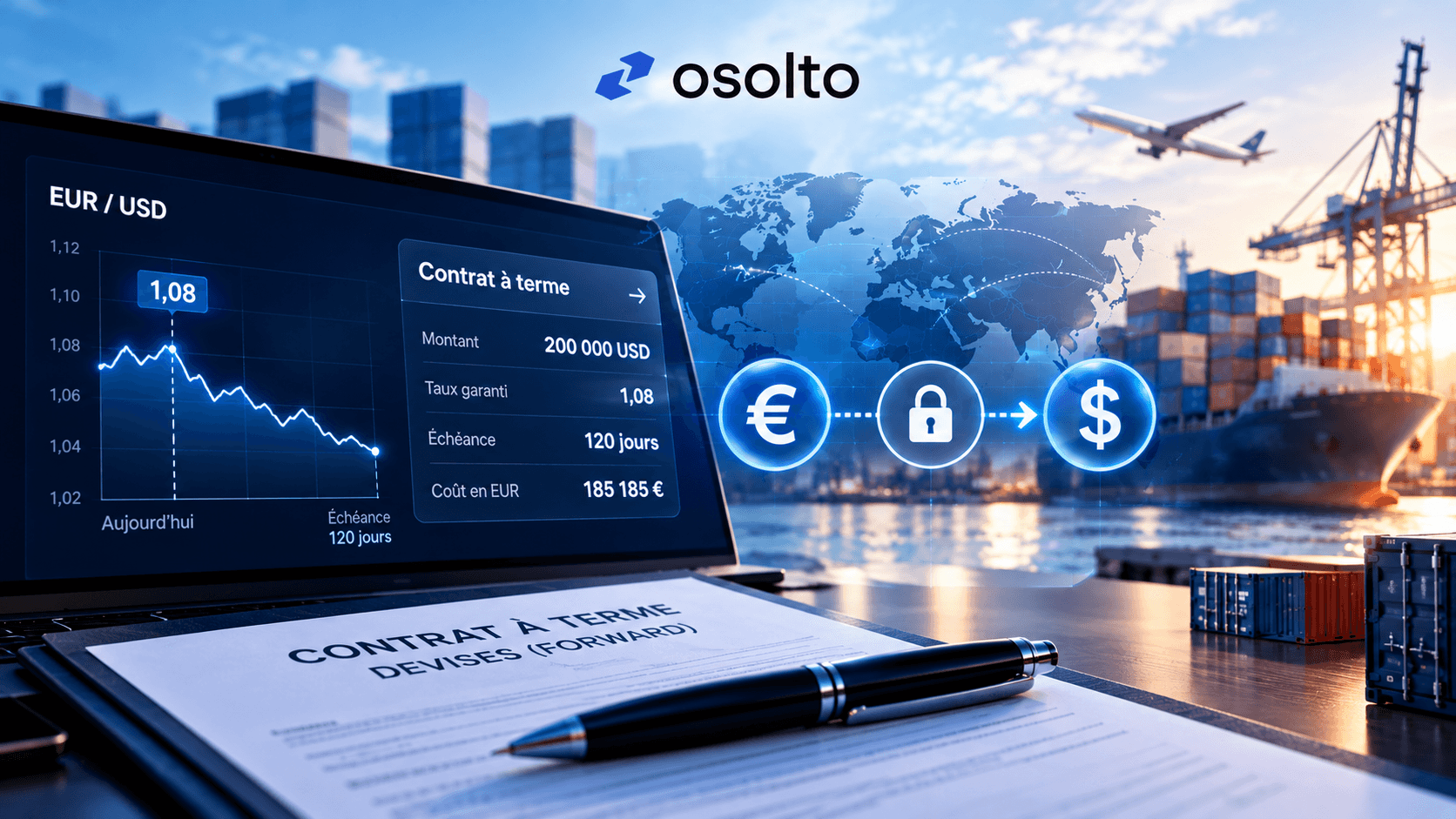
Secure large orders with a currency hedge.
OSolto, partner of Mahoran businesses
OSolto is an independent payment services broker registered with ORIAS. We compare the solutions of authorized partners specializing in B2B foreign exchange to offer companies in Mayotte the same conditions as in mainland France: rates negotiated and announced before each transaction, payments in many currencies depending on the partners, currency hedging and a single point of contact, without changing banks.
Do you also work with Réunion? Consult our guide to international payments in Réunion.
Do you pay suppliers in the Indian Ocean or Asia? Have your exchange costs analyzed for free. → Book an appointment
FAQ
Is Mayotte part of the SEPA zone?
Yes. Mayotte is an overseas department and an outermost region of the European Union, integrated into the eurozone and the SEPA area.
Does the Comorian franc have a fixed rate?
Yes. It is pegged to the euro at a fixed parity: €1 is worth 491.96775 Comorian francs. The cost of a payment to the Comoros therefore depends mainly on the fees of the international transfer.
How to pay a supplier in Madagascar from Mayotte?
By international SWIFT transfer, in euros or ariarys depending on the contract. Compare the rate applied and keep the corresponding invoice.
Can we pay directly in South African rands?
Yes, many specialized providers offer the rand. Paying in ZAR prevents the supplier's bank from setting the conversion rate itself.
Related Articles

Advice
9 Oct 2026
International payments in French Guiana: a practical guide for businesses

Guides
9 Oct 2026
International payments in French Overseas Territories: the complete guide for businesses in the DOM-TOMs
Advice
8 Oct 2026
Currency forward contract: the complete guide to securing your SME payments