
An importer in Saint-Denis, a distributor in Le Port, a hotelier in Saint-Gilles: in Réunion, almost all businesses will one day pay a supplier outside the eurozone. Ordering equipment from China, a service provider in Mauritius, supplying from South Africa: every payment involves a currency conversion and an international banking circuit, with fees that are often difficult to identify. Here is what you need to know to pay your foreign suppliers from Réunion at the same cost as a company in mainland France.
Réunion imports heavily, and from further and further afield
In 2024, Réunion imported approximately €7.1 billion worth of goods. Mainland France remains the leading supplier with 60% of purchases, but Asia comes in second with 20%, ahead of the European Union and the United Kingdom (14%), according to Insee. China and Malaysia each accounted for around 5% of imports in 2023.
In the Indian Ocean, South Africa, Mauritius and Madagascar are among the island's main regional suppliers according to IEDOM. A Réunion-based business therefore routinely handles US dollars, yuan, Mauritian rupees, ariary or rand.
What is identical to mainland France
Réunion is an overseas department and region, a member of the European Union and the eurozone. Your account has an FR IBAN, your transfers in euros to mainland France or Europe are SEPA transfers, and the compliance rules are those of any French business.
In other words, there is no reason why a payment to Port Louis or Shenzhen should cost you more from Saint-Pierre than from Bordeaux. For the complete framework, please consult our guide to international payments in overseas territories.
What complicates payments from Réunion
Regional currencies: Mauritian rupee (MUR), Malagasy ariary (MGA) or South African rand (ZAR) are not always offered, or on unclear terms. The payment is then made via the dollar or the euro, with a double conversion.
The time difference: Réunion is two hours ahead of Paris in summer, three in winter. An order placed at the end of the day in Saint-Denis may miss the cut-off time of a team based in mainland France.
Delivery times: with several weeks of maritime freight from Asia, the gap between ordering and paying the balance exposes you to variations in the dollar or yuan.
The exchange margin: rarely displayed, it often represents the largest cost item.
Quantified example: a Réunion-based importer
Take a business that pays the equivalent of €300,000 every year to Asian suppliers in dollars. If the margin applied to its conversions exceeds what it could get by one percentage point, the gap reaches €3,000 per year, even before SWIFT fees and those of intermediary banks. And if the dollar appreciates by 5% between the order and the payment of the balance, the invoice increases by the same amount on the uncovered portion.
To measure what a transfer costs you today, read also how much an international transfer actually costs.
5 best practices to pay less
Request the rate before executing each payment, and compare it to the current interbank rate.
Pay directly in the supplier's currency (MUR, ZAR, CNY, etc.) when possible, to avoid a double conversion through the dollar.
Consolidate payments to the same supplier to limit fixed fees.
Anticipate cut-off times by placing your orders in the morning, Réunion time.
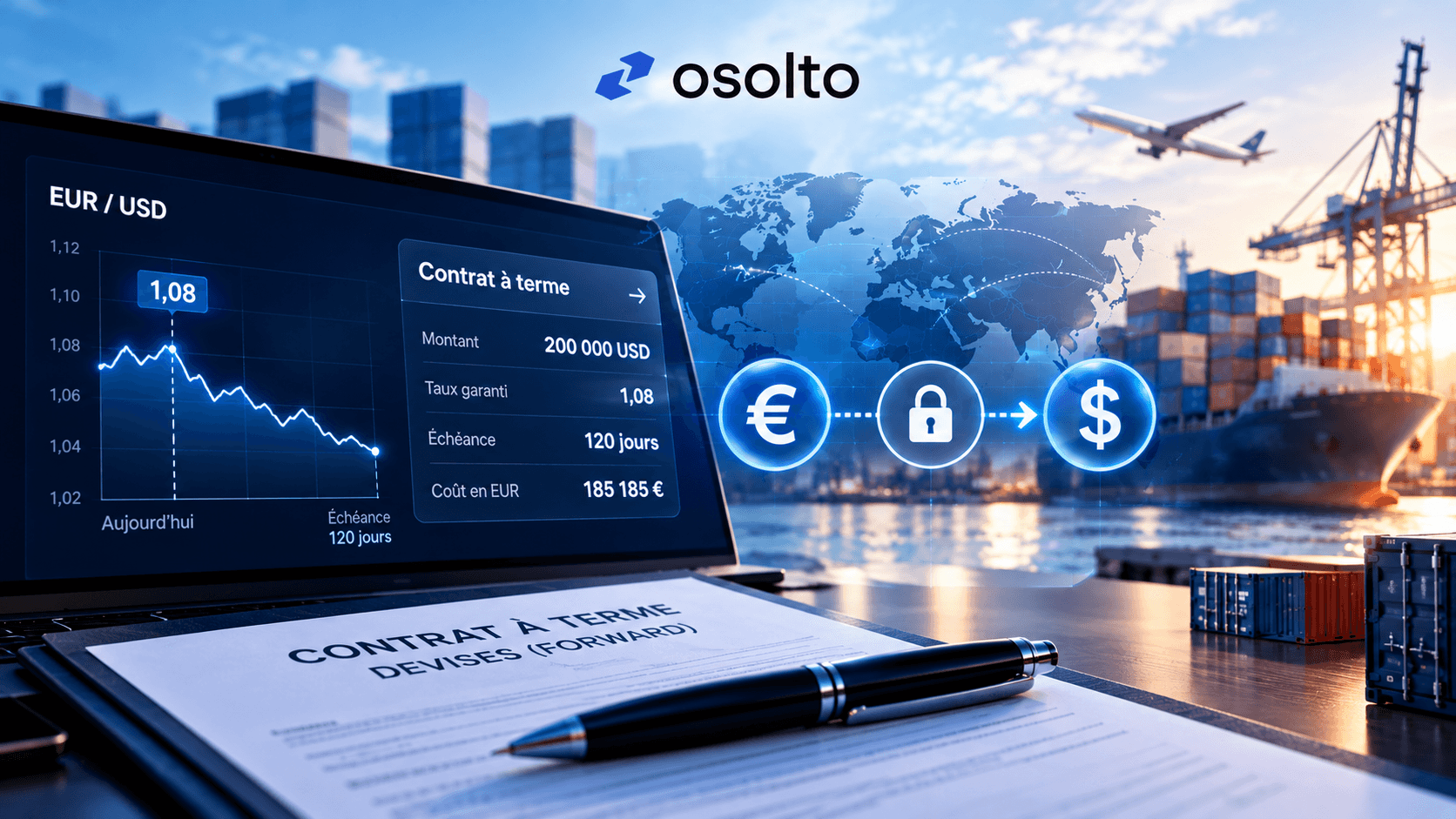
Secure large orders with a hedging solution, fixing the rate as soon as the order is placed.
OSolto, partner of businesses in Réunion
OSolto is an independent payment service broker, registered with ORIAS. We compare solutions from approved partners specialising in B2B foreign exchange to enable you to get the same conditions in Réunion as a company in mainland France: negotiated rates announced before each transaction, payments in many currencies, including those of the Indian Ocean depending on the partners, currency hedging and a single point of contact, without changing banks.
Do you also work with Mayotte? Consult our guide to international payments in Mayotte.
Do you pay suppliers in Asia or the Indian Ocean? Have your foreign exchange costs analysed for free. → Book an appointment
FAQ
Is Réunion part of the SEPA zone?
Yes. Réunion is an overseas department integrated into the European Union and the SEPA area. Your transfers in euros to mainland France or a European country are SEPA transfers.
How do I pay a supplier in Mauritius from Réunion?
By international transfer via the SWIFT network. If your supplier bills in Mauritian rupees, paying directly in MUR often avoids a double conversion. In any case, ask for the rate applied before executing the payment.
Why does my supplier receive less than the amount sent?
With the shared fees option (SHA), intermediary banks deduct their commission from the amount transferred. The OUR option allows you to take these fees on yourself so that the supplier receives the exact amount.
Can we protect ourselves against a rise in the dollar?
Yes. A forward contract allows you to fix the rate of a future payment today, for example the balance of an order delivered in three months.
Related Articles

Advice
9 Oct 2026
International payments in French Guiana: a practical guide for businesses

Guides
9 Oct 2026
International payments in French Overseas Territories: the complete guide for businesses in the DOM-TOMs
Advice
8 Oct 2026
Currency forward contract: the complete guide to securing your SME payments