
In Fort-de-France as in Le Lamentin, many companies buy part of their goods from outside Europe: equipment from the United States, materials from Brazil, agricultural products from the Caribbean. These payments in dollars or regional currencies go through the international banking network, with fees and exchange margins that are rarely detailed. This guide explains how to control them, with a simple principle: a Martinican company is entitled to the same conditions as a company in mainland France.
Where do imports to Martinique come from?
As in the other DROMs (French overseas departments and regions), mainland France and the European Union remain Martinique's primary suppliers. However, the island also sources goods from its regional environment: according to the IEDOM annual report, the United States, Brazil, the Dominican Republic and Trinidad and Tobago are among its suppliers on the American continent and in the Caribbean. Petroleum products, imported for the Lamentin refinery, also weigh heavily in the trade balance.
These purchases are mainly settled in US dollars (USD), but also in Brazilian reals (BRL), Dominican pesos (DOP) or East Caribbean dollars (XCD), the currency of Dominica and St Lucia, which is pegged to the US dollar at a fixed rate (2.70 XCD for 1 USD).
Euro, SEPA, FR IBAN: the same rules as in Paris
Martinique is an outermost region of the European Union. It uses the euro and belongs to the SEPA area: a transfer in euros to mainland France, Guadeloupe or another European country is a SEPA transfer, and businesses in Martinique have an FR IBAN. Compliance obligations and authorised payment service providers are exactly the same as in mainland France.
There is therefore no structural reason to pay an American supplier more from Fort-de-France than from Nantes. For the general framework, consult our guide to international payments in the French Overseas Territories.
Difficulties specific to Martinique
High exposure to the dollar: many purchases of equipment and raw materials are invoiced in USD. Every variation in the euro against the dollar impacts your margins.
The time difference: Martinique is six hours behind Paris in summer, five in winter. An order placed at 2 pm in Fort-de-France arrives after 7 pm in Paris, often too late to be processed on the same day.
Caribbean currencies: XCD, DOP or Trinidad and Tobago dollars (TTD) are rarely offered under favourable conditions, which encourages paying in dollars and letting the supplier convert.
Intermediary fees: a payment to the United States or the Caribbean often transits through an American correspondent bank, which charges its own commission.
Concrete example: a distributor in Martinique
A distributor settles the equivalent of €200,000 in dollars each year to American suppliers. An extra percentage point on the exchange margin costs them €2,000 per year. And on an order of €50,000 paid three months after signing, a 5% rise in the dollar represents an additional cost of €2,500 if the rate has not been secured.
Best practices
Compare the offered rate with the interbank rate before each payment in dollars.
Place your orders in the morning, Martinique time, to meet processing cut-off times.
Choose the appropriate fee option (SHA or OUR) to avoid unpleasant surprises for the supplier.
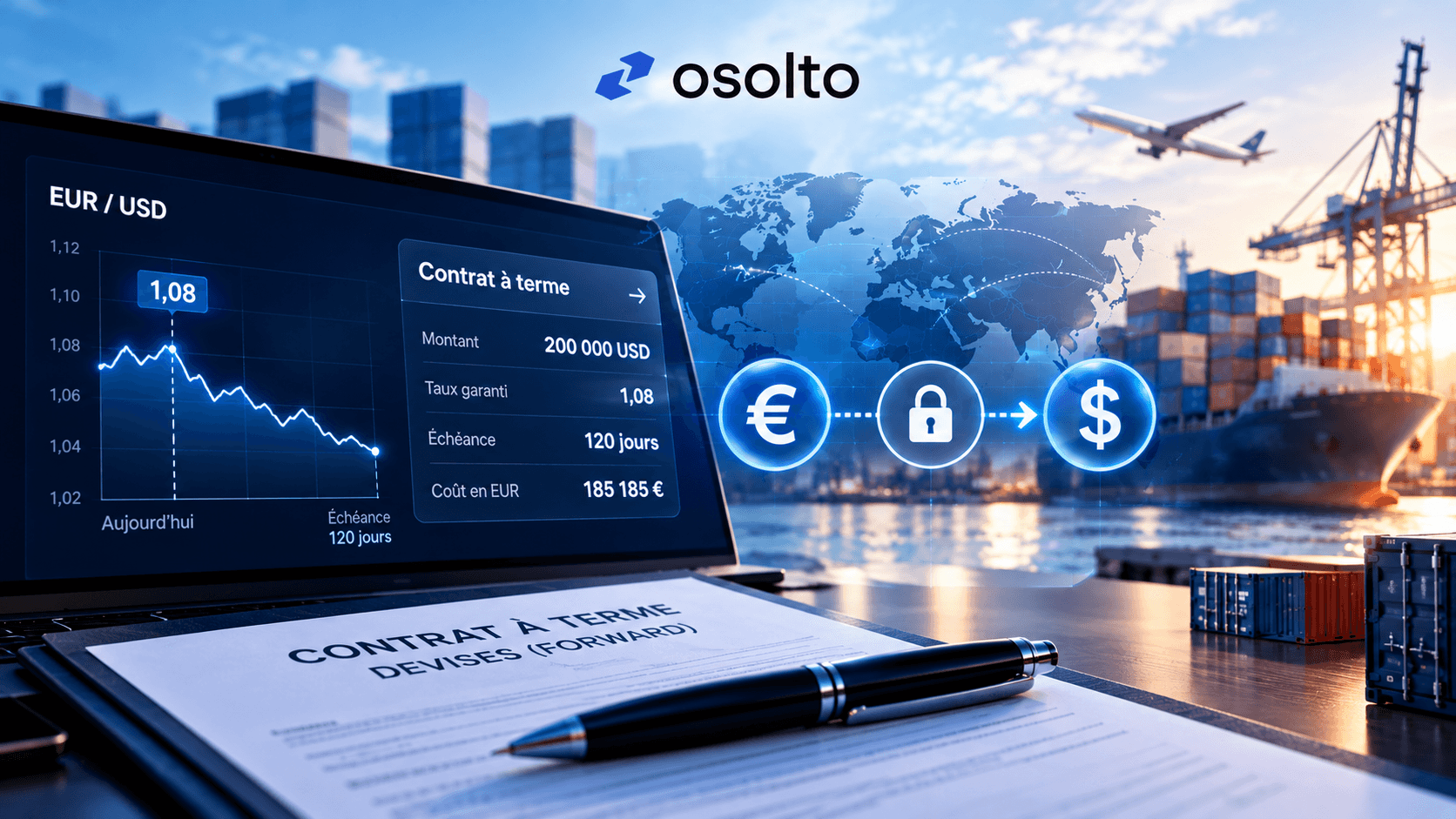
Secure your orders with a forward contract as soon as the amount and the due date are known.
Do you export rum or agricultural products? Invoicing in your clients' currency can become an advantage: read why invoicing in local currency changes everything for your margins.
OSolto, partner to businesses in Martinique
OSolto is an independent broker in payment services, registered with ORIAS. We compare solutions from authorised partners specialising in B2B foreign exchange to enable you in Martinique to benefit from the same conditions as a business in mainland France: negotiated rates announced before each transaction, multi-currency accounts, currency hedging and a single point of contact, without changing bank.
Do you also have business activities in Guadeloupe? Consult our guide to international payments in Guadeloupe.
Do you pay suppliers in dollars from Martinique? Get a free analysis of your foreign exchange costs. → Book an appointment
FAQ
Is Martinique part of the SEPA zone?
Yes. Martinique is an outermost region of the European Union, integrated into the eurozone and the SEPA area. Your euro transfers to mainland France or Europe are SEPA transfers.
How to pay a supplier in the United States from Martinique?
By SWIFT international wire transfer in dollars. You need the beneficiary's name and address, their account number, their bank's SWIFT/BIC code and, often, their routing number (ABA). Ask for the applied rate before executing the payment.
Is the East Caribbean dollar risky?
The XCD is pegged to the US dollar at a fixed rate (2.70 XCD for 1 USD). The risk for a business in Martinique is therefore that of the euro against the dollar.
Why do my payments go through the next day?
Because of the time difference: an order placed in the afternoon in Martinique arrives after the processing cut-off time in Europe. Placing orders in the morning limits this risk.
Related Articles

Advice
9 Oct 2026
International payments in French Guiana: a practical guide for businesses

Guides
9 Oct 2026
International payments in French Overseas Territories: the complete guide for businesses in the DOM-TOMs
Advice
8 Oct 2026
Currency forward contract: the complete guide to securing your SME payments