30/70 supplier payment: the guide to securing your cash flow throughout the freight cycle

30% on order, 70% on arrival of the freight. This is the most common payment term with suppliers in Asia, and it seems simple on paper. In practice, between the time you pay the deposit and the time you settle the balance, several weeks, sometimes several months, pass by. And during all this time, your business remains exposed to a risk that many managers discover too late: exchange rates can move, and the final balance can cost significantly more than expected at the time of ordering.
With current delays in ocean freight (see our article on the consequences of the Straits of Hormuz and Bab-el-Mandeb), this exposure window is lengthening even further. Here is how to structure and secure this type of payment.
What "payment on arrival" really means
The phrasing "70% on arrival of the freight" often hides an ambiguity that can prove costly in the event of a dispute. Arrival where, exactly? At the port of destination, at your warehouse, on the date indicated on the bill of lading? These three milestones can be separated by several days, or even several weeks if customs clearance drags on.
Before signing, clarify in writing in the purchase order or contract the exact triggering point for the payment of the balance, and the Incoterm used (FOB, CIF, DAP, etc.). The Incoterm determines when the risk and transport costs shift from your supplier to you, which has a direct impact on your payment obligations and insurance coverage.
The real risk: the duration of exposure to the exchange rate
The danger is not so much the payment itself as the time separating the two instalments. Let us take a simple example: an order of 100,000 dollars, with 30,000 dollars paid on signing and 70,000 dollars paid on arrival, eight to ten weeks later. If the exchange rate moves unfavourably by just 1% over this period, that represents 700 dollars of additional, unanticipated cost on this single tranche alone.
On larger annual volumes, repeated over several orders, this difference can represent tens of thousands of pounds per year, without anything having changed in your business itself.
With the current lengthening of transit times (an additional 10 to 15 days on Asia-Europe routes due to routing around the Cape of Good Hope), this risk window extends accordingly, often without the business being fully aware of it when setting its selling prices.
Pitfalls to avoid when settling the balance
Before paying the 70% balance, several checks are necessary:
Confirm that the shipping documents (bill of lading, packing list, commercial invoice) correspond exactly to the order placed
Remain vigilant against attempts at bank details change fraud, which are particularly frequent on high-value international transactions
Verify the consistency between the actual shipping date and the announced date, especially during periods of logistical disruption when schedules easily slip
A check that takes a few minutes can prevent weeks of procedures to recover incorrectly sent funds.
How to secure your two payment tranches
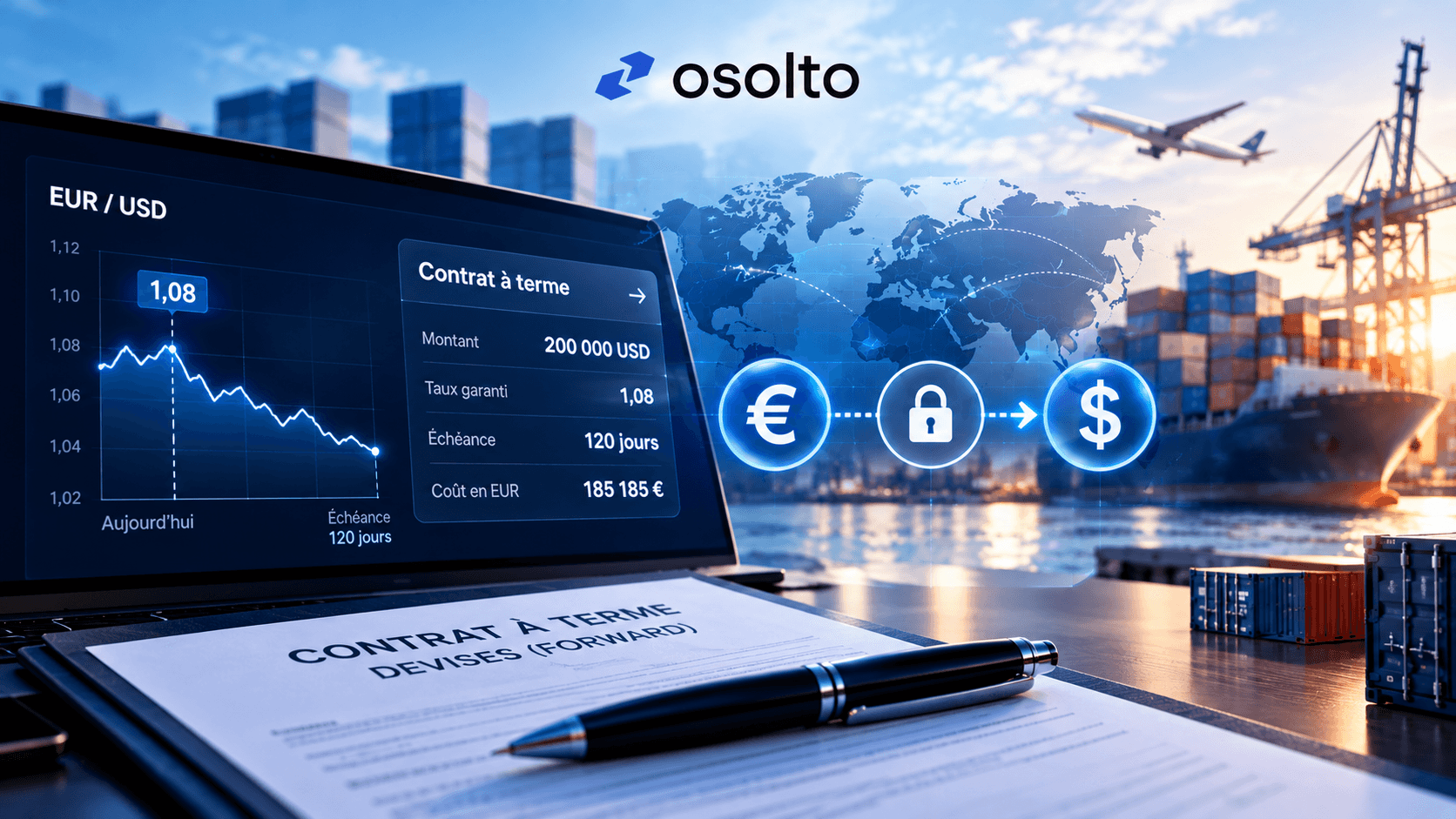
The best practice consists of fixing the exchange rate as soon as the order is confirmed, for both tranches, rather than discovering the applicable rate as you go along. This allows you to know the total cost of the order, in euros, right from the start, and to set your selling prices accordingly without any unpleasant surprises.
If transit times lengthen along the way, which is common in the current context, it is important to anticipate that your currency hedging may sometimes need to be adjusted to remain aligned with the new actual payment date of the balance.
Regulated payment intermediaries like OSolto, supervised by the ACPR and registered with ORIAS, provide access to hedging solutions (forward contracts) allowing you to fix an exchange rate in advance for each payment deadline, with support to adjust these hedges if the delivery schedule changes. The team, with its cumulative years of experience in the foreign exchange markets, helps importing SMEs in particular to structure their supplier payments according to their actual purchasing cycles.
In summary
The 30/70 scheme is not risky in itself. What is risky is leaving the balance exposed to market movements for weeks without paying attention to it. Clarifying the trigger for payment, checking documents before settling the balance, and securing the exchange rate upon ordering are the three reflexes that protect your margin.
Do you import regularly and want to review your current payment terms? A free analysis of your flows will quickly identify the available room for manoeuvre.
FAQ
Can I secure a different exchange rate for the deposit and for the balance?
Yes, each payment tranche can be subject to a separate hedge, tailored to its own maturity date.
What happens if the freight is delayed and my currency hedge matures before the balance is paid?
This is a common case at the moment. An advisor can adjust the maturity of the hedge so that it remains aligned with the actual payment date.
Is the rate fixed in advance guaranteed regardless of market movements?
Yes, this is precisely the benefit of a forward contract: the agreed rate applies at maturity, whether the market has moved favourably or not.
Do I need to renegotiate my 30/70 terms with my supplier if transit times increase?
It is not compulsory, but it is often an opportunity to clarify in writing the exact triggering point for the payment of the balance, to avoid any disagreement in the event of a delay.
Related Articles

Guides
9 Oct 2026
International payments in French Overseas Territories: the complete guide for businesses in the DOM-TOMs
Advice
8 Oct 2026
Currency forward contract: the complete guide to securing your SME payments

Advice
7 Oct 2026
Receiving a foreign currency payment on Revolut Business: how much does it really cost (and how to pay less)